
How Communication Skills Help Children Become Better Thinkers
Your child drops an ice cube into a glass of water and watches it float.
“Why does it stay at the top?” you ask.
They look closely, move the glass and pause. Perhaps they say, “Because it’s cold.” Perhaps they point to the ice, draw what they noticed or ask a question of their own.
That small moment involves more than learning a science fact. Your child is observing, recalling what they already know, forming an idea and finding a way to communicate it.
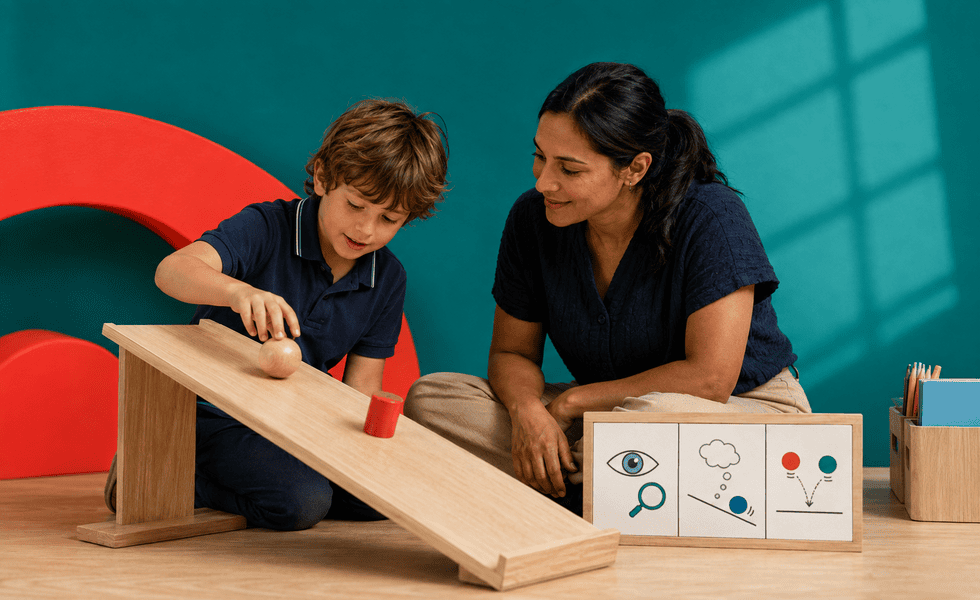
Communication and thinking often work together. Words, signs, gestures, drawings, visuals, writing and AAC can all help children notice details, compare possibilities, make predictions, explain what happened and revisit an idea after learning something new.
This does not mean that strong speaking skills equal intelligence, or that a child who needs more time is not thinking deeply. It means that accessible communication gives children more tools for exploring and sharing their thinking.
With National Science Week taking place across Australia from 15–23 August 2026, it is a useful time to notice how much language is involved whenever children investigate the world around them.
Thinking is not limited to spoken words
Children do not all show their thinking in the same way.
One child might explain an idea aloud. Another might demonstrate it with objects, arrange pictures in order, draw a diagram, type a response, use signs or select words on an AAC device.
A quick spoken answer is only one way to respond. Some children understand an idea but need more time or structure to express it. Others communicate more clearly when they can see the information or act on it.
The NSW Department of Education’s current early-learning curriculum resource connects learning and thinking with problem-solving, inquiry, experimentation and hypothesising. It also recognises that children communicate verbally and non-verbally and express ideas through a range of media (Curriculum links for early childhood services).
The goal is not to make every child communicate in one preferred way. It is to give them meaningful ways to develop, test and share their ideas.
For more about respecting different ways of expressing ideas, read Speakable’s guide to neurodiversity-affirming therapy.
The language hidden inside thinking tasks
Many activities described as “thinking skills” also carry a significant communication load.
A child might need to understand the question, know the relevant vocabulary, hold information in mind, organise their response and communicate it to someone else. If one part is difficult, the final answer may not fully show what the child understands.
The Australian Curriculum: Science describes science inquiry as investigating ideas, developing explanations, solving problems, drawing conclusions, evaluating claims and communicating findings.
Here is how communication can support some of those processes.
Noticing and describing
Before children can compare or explain, they need a way to identify what they notice.
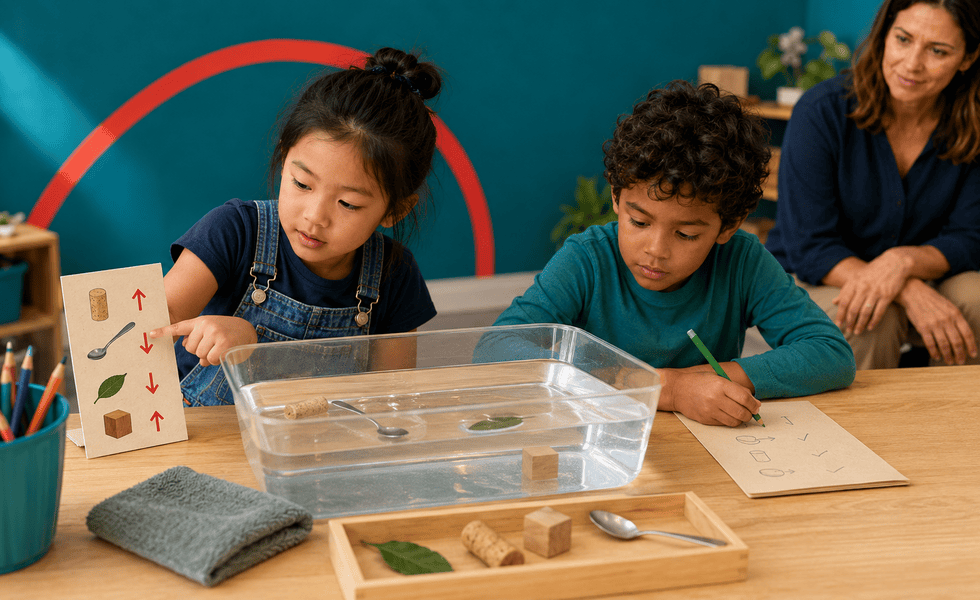
Words and concepts such as rough, smooth, heavier, melting, faster, same and different can help children pay attention to particular features. Gestures, photographs, symbols and demonstrations can serve the same purpose when spoken language is not the easiest starting point.
A child might first point to two objects, then learn language that helps them describe the difference more precisely.
Comparing and sorting
Comparing requires children to hold two or more pieces of information in mind and consider how they are related.
They may need language such as:
- both;
- but;
- same;
- different;
- more or less;
- heavier or lighter;
- before and after; and
- belongs or does not belong.
These concepts appear across science, mathematics, reading and everyday problem-solving.
Predicting
A prediction is not simply a guess. It brings together what a child notices, what they already know and what they think might happen next.
Useful language might include:
- “I think…”
- “Maybe…”
- “It might…”
- “If we do this, then…”
- “My prediction is…”
A child does not need a complete sentence before they can make a meaningful prediction. They might choose between two pictures, point to an outcome, act it out or place an object where they think it will go.
Explaining cause and effect
Explaining asks children to connect events and make the relationship clear to someone else.
This often involves words such as because, so, when, if and therefore. It can also involve sequencing: what happened first, what changed and what happened next.
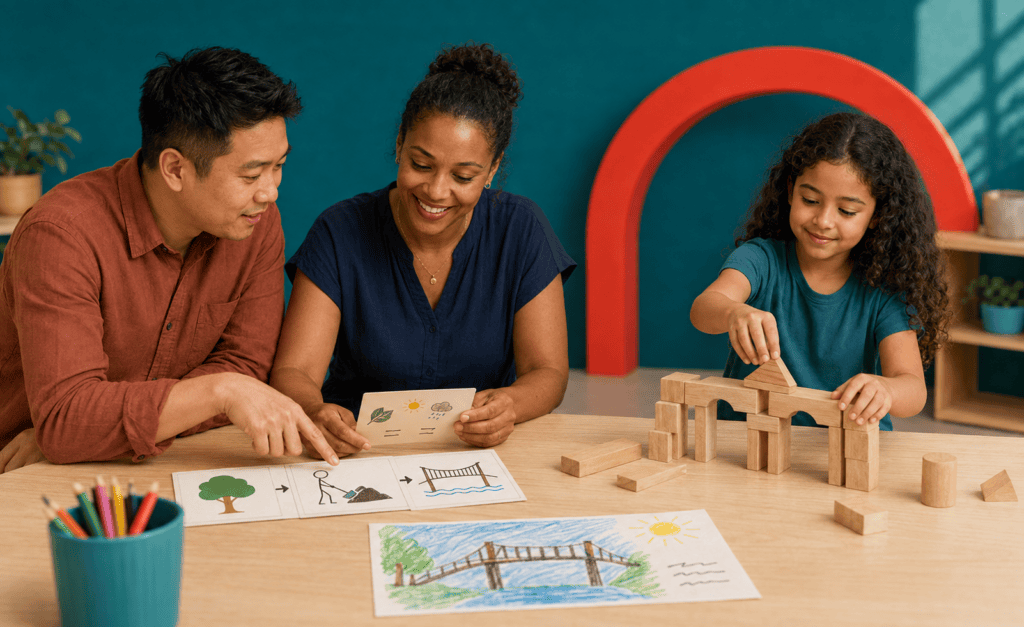
A child might know that a tower fell but find it difficult to explain that the base was too narrow. Showing photographs of each stage or rebuilding the tower can make the thinking easier to communicate.
Asking questions and seeking clarification
Questions help children identify what they do not yet know.
They may ask:
- “What will happen if…?”
- “Why did that change?”
- “Can we try it another way?”
- “What does that word mean?”
- “Can you show me?”
Asking for clarification is also an important thinking skill. It allows a child to notice that information is missing and take action to understand it.
Solving problems and revising ideas
Problem-solving rarely follows a perfectly straight line.
Children may need to describe the problem, generate possible solutions, choose what to try, notice the result and decide what to change.
Communication makes this process visible. A child might talk through it, use a visual plan, draw alternatives or work with another person.
Changing an idea after seeing new evidence is not failure. It is part of inquiry. The Australian Curriculum connects critical and creative thinking in science with questioning, predicting, investigating, analysing evidence and drawing conclusions (STEM curriculum links).
What this can look like in everyday life
Children do not need special equipment to practise the communication involved in thinking. Everyday moments already offer many opportunities.
| Everyday moment | Thinking involved | Communication that may help |
|---|---|---|
| Building a block tower | Planning, predicting and revising | “What could make the base stronger?” |
| Cooking together | Sequencing, measuring and noticing change | A picture recipe, first–next–last or “What changed when we mixed it?” |
| Watching rain collect outside | Observing, comparing and predicting | “Which container has more?” or pointing to a visual choice |
| Sorting laundry | Categorising and explaining a rule | “How did you decide where this belongs?” |
| Reading a story | Inferring, predicting and considering another perspective | “What makes you think that?” |
| Fixing a toy or game | Identifying a problem and testing solutions | Drawing two options or showing what is not working |
| Walking in the park | Noticing patterns and asking questions | Photographing, collecting, describing or sketching what the child notices |
The aim is not to question children continuously. Shared curiosity is more valuable than turning an ordinary activity into a test.
How adults can support thinking through communication
Wonder alongside the child
Adults do not always need to provide the answer immediately.
Try:
“I noticed that too. I wonder why it happened.”
This invites exploration without requiring the child to produce a correct response on demand.
Ask one manageable question
A broad question such as “Explain everything that happened” can be difficult to process.
Start with one part:
- “What did you notice first?”
- “Which one changed?”
- “What do you think might happen next?”
- “Do you think it will stay the same or change?”
One clear question gives the child a more accessible place to begin.
Give genuine thinking time
After asking a question, pause.
Repeating, rewording or answering too quickly can interrupt the child while they are still processing. A quiet wait, a visual choice or the invitation to show rather than tell may make the response easier.
Model the language of thinking
Adults can make their own thought process visible:
“I thought the big object would sink, but it floated. Now I’m wondering whether size is the most important part.”
This models predicting, noticing evidence and revising an idea without asking the child to copy the sentence.
Use visuals and objects
Real objects, photographs, drawings, diagrams, key words and simple sequences can reduce the amount of information a child needs to hold in mind.
For example, three cards labelled prediction, what happened and why can provide a structure for an explanation.
Visual support is not a shortcut that replaces thinking. It can make the thinking process easier to access and communicate.
Accept different forms of response
A meaningful answer might be spoken, drawn, typed, signed, selected, acted out or communicated through AAC.
If the goal is to understand the child’s reasoning, allow them to use the communication method that helps them show it.
Expand the idea without taking it over
If a child says:
“It fell. Too tall.”
An adult might respond:
“Yes, it became very tall and then it fell. I wonder if the small base made it wobbly.”
This adds useful language while respecting the child’s original contribution.
Revisit the prediction
After trying something, return to the earlier idea:
- “What happened?”
- “Was it the same as your prediction?”
- “What did we find out?”
- “What could we try next?”
Revisiting helps connect the prediction, evidence and conclusion.
When language demands hide a child’s thinking
Sometimes adults see an incomplete answer and assume that the child has not understood the idea.
But the task may require the child to manage several things at once:
- understand unfamiliar vocabulary;
- follow a multi-step instruction;
- remember what they observed;
- compare it with an earlier prediction;
- organise the events in order;
- retrieve the right words; and
- respond within the available time.
A child may understand the practical activity but struggle with the language used to discuss it. They may complete a multiple-choice task but find an open-ended explanation harder. They may contribute more successfully one-to-one, with a visual or after having time to prepare.
Parents and teachers might notice that the child:
- gives very short answers even when they appear to understand;
- finds why, how, compare or explain questions difficult;
- uses broad words such as “thing”, “stuff” or “that”;
- loses the sequence while describing what happened;
- copies another child’s response rather than sharing their own;
- has difficulty asking for clarification;
- shows their understanding more clearly through actions or drawings;
- becomes quiet or frustrated when expected to answer quickly; or
- produces written work that does not fully reflect what they know.
These signs do not lead to one automatic conclusion. Vocabulary, language processing, word retrieval, attention, working memory, literacy, sensory demands, anxiety, familiarity with the topic and the communication environment can all influence a response.
Speakable’s articles Why Kids “Don’t Listen” — Understanding Attention & Processing and Executive Functioning Explained: Why It Matters for Learning explore some of these connected demands.
The most useful question is not simply, “Did they get it right?” It is, “What helped this child show what they know?”
When might a speech pathologist help?
It may be worth speaking with a speech pathologist when communication demands regularly make it difficult for a child to participate, explain ideas or demonstrate their learning.
Support may explore areas such as:
- understanding questions and instructions;
- learning and using new vocabulary;
- understanding concepts used for comparison, time, sequence and cause;
- retrieving words;
- organising sentences and explanations;
- retelling events in a clear order;
- asking questions or requesting clarification;
- using visuals or AAC to support communication;
- reading comprehension and written language; and
- communicating ideas in classroom and social settings.
An assessment should consider the child’s strengths, communication preferences, languages, environments and the situations in which participation is easier or harder.
Healthdirect Australia explains that speech pathologists support communication areas including listening, reading, writing, social skills and understanding language.
Speakable’s guide to expressive language support provides more detail about helping children organise and share their ideas.
Curiosity needs room to communicate
Children show thoughtful ideas in many different ways.
The aim is not to turn every question into a performance or expect one “correct” style of communication. It is to create enough time, structure and flexibility for children to notice, wonder, compare, predict, explain and reconsider.
This National Science Week, try following your child’s curiosity. Pause at an unexpected result. Wonder aloud. Draw a prediction. Test an idea together. Accept a gesture, picture or demonstration as part of the conversation.
When communication becomes more accessible, children have more opportunities to show the thinking that may already be there.
If your child finds it difficult to understand questions, organise explanations or communicate what they know, Speakable can help you explore their communication profile and identify practical supports for home and school.
Contact Speakable to start a conversation.
Save these ideas for Science Week and share them with a parent, carer or educator.