

Why Some Children Understand More Than They Can Say
Your child has just listened to a story and laughed at all the right moments. They followed the instructions, found the correct page and clearly seemed to understand what was happening.
Then someone asks, “Can you tell me what the story was about?”
There is a long pause. Your child says, “I don’t know,” gives a very short answer or looks to you for help.
It can be confusing when a child appears to understand an idea but has difficulty putting that understanding into words. Parents and teachers might wonder whether the child was listening, whether they have forgotten the information or whether they simply do not want to answer.
But understanding language and expressing language are different skills. A child can take in more information than they can easily organise and communicate — especially when they are expected to respond quickly, explain something in detail or speak in front of other people.
When “I don’t know” does not mean “I don’t know”
Sometimes “I don’t know” really does mean that a child is unsure. At other times, it can be the quickest available response when finding the right words feels difficult.
The child may know the answer but need more time to:
- retrieve the words they want;
- decide which information is important;
- organise ideas in the right order;
- build a sentence;
- remember the question while forming an answer; or
- feel comfortable enough to share what they know.
This is not a reliable measure of intelligence, effort or interest. It tells us that we may need to look more closely at the communication demands of the task and the support available to the child.
Understanding language and using language are different skills
Language includes much more than spoken words. It helps children understand and use vocabulary, grammar, stories, explanations, written information, gestures and symbols.
The Victorian Department of Education describes language as a two-way process that supports learning across the curriculum, including literacy and numeracy (Supporting students with language difficulties).
Receptive language: taking information in
Receptive language is the ability to understand messages. At school, children use receptive language when they:
- follow instructions;
- understand questions;
- learn new vocabulary;
- listen to stories or explanations;
- interpret concepts such as before, unless, compare and explain; and
- understand information communicated through speech, writing, gesture or visuals.
Expressive language: sharing information with others
Expressive language is how a child communicates thoughts, knowledge, needs and feelings. It includes:
- choosing and retrieving words;
- combining words into sentences;
- explaining how or why something happened;
- retelling events in a clear order;
- asking questions;
- contributing to conversations; and
- organising ideas for speaking and writing.
These skills do not always develop evenly. A child might understand a classroom discussion but find it difficult to explain the same idea. They might recognise the answer in a multiple-choice task but struggle with an open-ended question.
They may also communicate more successfully through drawing, gesture, writing, signs, AAC or a visual choice than through an immediate spoken response.
Speakable’s article How Speech Pathologists Support Expressive Language explains this part of communication in more detail.
Why the difference can become more noticeable at school
As children move through primary school, they are increasingly expected to do more than remember facts. They need to explain their reasoning, describe connections, make predictions, retell information and show what they know through spoken and written language.
A familiar routine might be easy to follow because the child can use context, repetition and visual cues. A new task can be harder because they must process the instructions and plan a response at the same time.
Classroom pace can also matter. A child may have the knowledge but need longer than the available pause between a teacher’s question and another student answering. In a busy group, they may decide that staying quiet is safer or easier than trying to assemble an answer under pressure.
Language also works alongside attention, memory and planning. Holding a question in mind, selecting relevant details and putting those details in order can place extra demand on executive functioning.
You can read more about this connection in Executive Functioning Explained: Why It Matters for Learning.
Signs parents and teachers may notice
There is no single behaviour that confirms an expressive language difficulty. Look for patterns across different tasks, settings and communication partners.
A child might:
- understand instructions but struggle to explain them to someone else;
- answer open-ended questions with “I don’t know”, “stuff” or “that thing”;
- pause for a long time or lose their place while speaking;
- know a word but have difficulty retrieving it at the right moment;
- use shorter or less detailed sentences than their understanding suggests;
- find it hard to retell a story or describe what happened during the day;
- leave out important people, events or connections when explaining something;
- give a correct answer but struggle to explain how they reached it;
- communicate more clearly one-to-one than in a group;
- rely on gestures, pictures, examples or another person to help complete the message;
- produce written work that does not fully show what they know; or
- avoid speaking tasks, become frustrated or appear less confident when put on the spot.
These signs can have many explanations. Fatigue, anxiety, sensory overload, unfamiliar vocabulary, attention, hearing, speech production, working memory and the classroom environment can all affect how easily a child communicates.
Observation is a starting point, not a diagnosis.
A note for multilingual families
Using more than one language does not cause a speech or language delay. Children may have different vocabulary and communication experiences across their languages, so their skills should be considered across all the languages and contexts they use.
Families should continue speaking the language or languages that feel most natural at home. Speech Pathology Australia also encourages families to maintain meaningful communication experiences in their home languages (Understanding and speaking “between the flags”).
Practical ways to make expression easier
Support does not need to turn everyday conversation into a test. Small changes can reduce pressure and give a child more ways to show what they know.
Give genuine thinking time
After asking a question, pause. Try not to repeat the question immediately or fill the silence. A calm wait can give the child time to retrieve words and organise a response.
You can say:
“Take your time — I’m listening.”
Make a broad question more manageable
“What did you do at school?” can require a child to search through an entire day. A more specific starting point may help:
- “What did you work on after lunch?”
- “Was the experiment about water or plants?”
- “Tell me one thing that was different today.”
The aim is not to restrict the child’s answer. It is to provide a useful place to begin.
Use visuals to help organise ideas
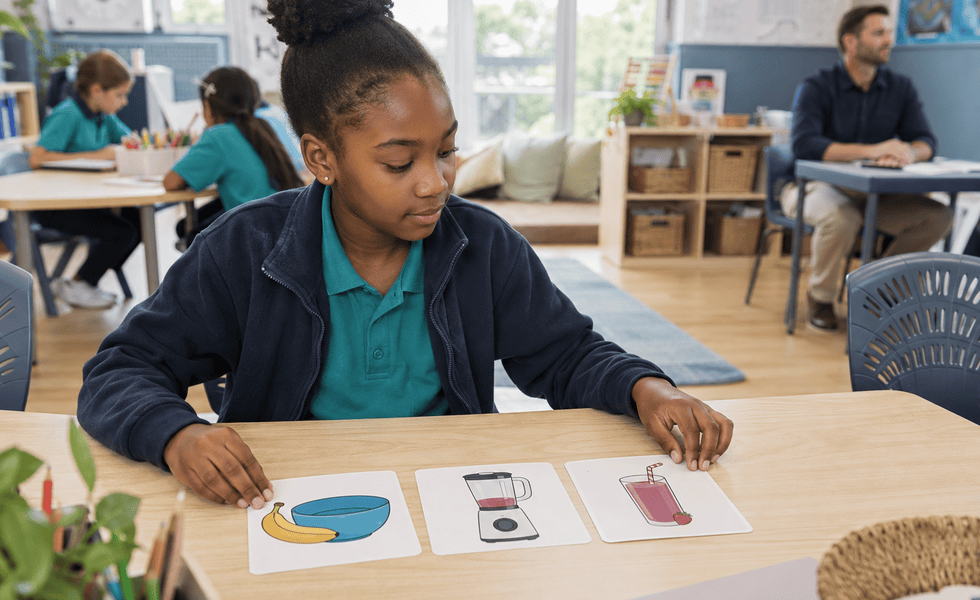
Photos, drawings, key words, story maps and simple sequences such as first–next–last can make ideas easier to hold and organise.
At school, a model answer, word bank or sentence starter can help a child begin without completing the response for them.
The Victorian Department of Education includes visual supports, word banks, sentence starters and models among its recommended expressive-language classroom adjustments (Supporting students with language difficulties).
Model language without making every conversation a correction
If your child says:
“The boy goed home because rain.”
You might respond:
“Yes, the boy went home because it started raining.”
This provides a helpful model while keeping the focus on the child’s meaning. They do not always need to repeat the corrected sentence.
Accept different ways of communicating
A child may use speech, gesture, drawing, typing, signs, visuals or AAC. These are all valid ways to contribute.
Offering options can reduce the pressure of having to produce a spoken answer immediately.
Share what helps
Parents and teachers often see different parts of a child’s communication. Compare observations and note what changes the experience.
Does the child respond more fully with extra time? With a visual? One-to-one? After seeing an example?
This information is more useful than simply recording that the child “did not answer”.
When to consider support from a speech pathologist
It may be helpful to speak with a speech pathologist when difficulties expressing ideas are persistent or are affecting a child’s:
- classroom participation;
- ability to demonstrate their learning;
- conversations and friendships;
- reading or writing;
- confidence; or
- comfort when communicating.
You do not need to know whether the difficulty is receptive language, expressive language, word retrieval, speech, literacy or something else before asking for advice.
A speech pathologist can gather information from the child, family and school, observe how the child communicates and explore the areas relevant to their needs.
Depending on the concern, an assessment may consider receptive language, expressive language, speech, literacy and social communication. Speech Pathology Australia provides more information about speech pathology assessments and reports, while Healthdirect’s overview of speech pathology explains the profession and how to access support in Australia.
For a broader introduction, you can also read Speakable’s What is Speech Pathology?.

Helping children show what they know
When a child understands more than they can say, the answer is not to increase pressure or speak for them every time.
It is to make communication more accessible: allow time, provide structure, accept different forms of expression and notice the conditions in which the child communicates most successfully.
With the right support, children can develop clearer ways to organise and share their ideas while knowing that their thoughts are worth waiting for.
If your child seems to understand but regularly has difficulty expressing what they know, the team at Speakable can help you explore what may be getting in the way and identify practical strategies for home and school.
Contact Speakable to start a conversation.