
Why Kids “Don’t Listen” — Understanding Attention & Processing
Why following instructions can be harder than it looks.
💬 Why “not listening” is not always about behaviour
Many parents know the feeling.
You ask your child to get their shoes, pack their bag and brush their teeth.
A few minutes later, they are still standing in the same place — or doing something completely different.
It can look like they were not listening.
But sometimes, children do hear the words. The difficulty may come after that.
They may struggle to process the information, remember the steps, organise what to do first or stay focused long enough to follow through.
This does not mean behaviour is never part of the picture. But it does mean that “not listening” can sometimes be a sign that the task is too big, too fast or too unclear for the child’s attention and memory system.
Good to know
When a child seems not to listen, it can help to ask:
Did they hear me, understand me, remember the steps and know what to do next?
Those are different skills.
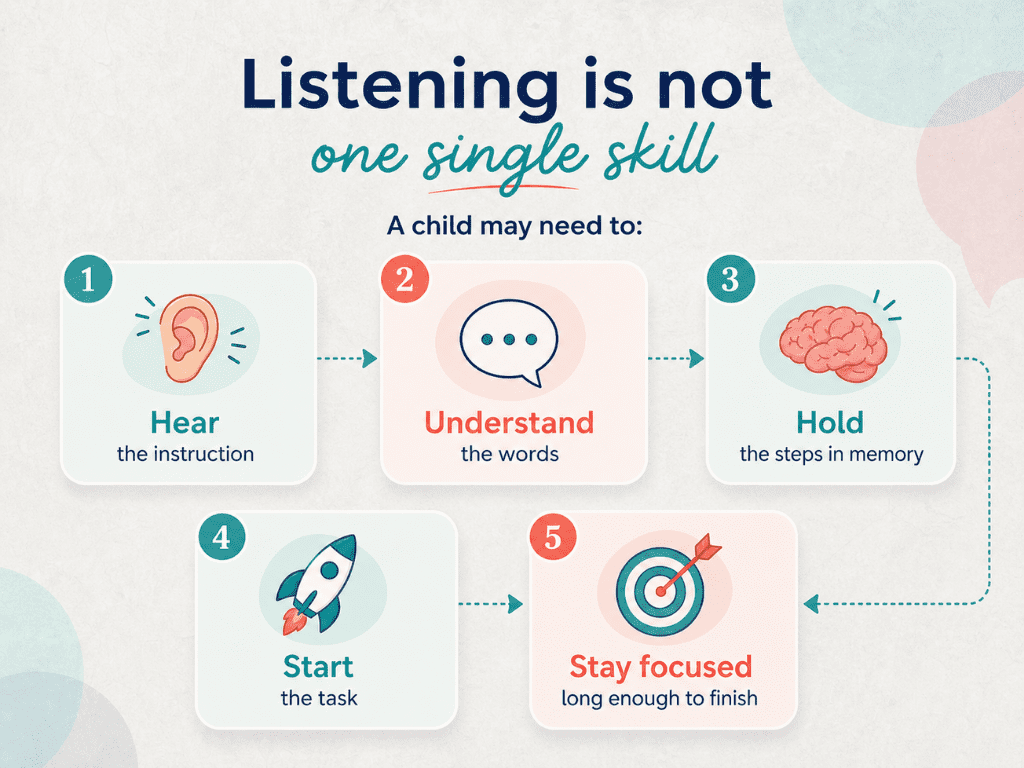
🧠 Listening is not one single skill
Listening sounds simple, but it is actually a chain of smaller skills.
A child may need to:
| Step | What the child needs to do |
|---|---|
| 1. Hear | Notice that someone is speaking |
| 2. Understand | Make sense of the words |
| 3. Hold | Keep the steps in memory |
| 4. Start | Know what to do first |
| 5. Stay focused | Continue long enough to finish |
That is a lot for a busy brain.
For some children, the problem is not that they ignored the instruction. It may be that the instruction disappeared from memory before they could act on it.
For others, the words may have been heard, but not fully processed. This is especially common when there is background noise, a busy environment, tiredness, stress or too much information given at once.
🔍 What attention, processing and memory mean
These terms can sound clinical, but they show up in very ordinary moments at home and school.
| Skill | What it means in everyday life |
|---|---|
| Attention | Being able to notice and focus on important information |
| Processing | Making sense of what was heard or seen |
| Working memory | Holding information in mind long enough to use it |
| Follow-through | Starting and completing the task |
A child might be able to repeat an instruction but still struggle to complete it.
That can happen because repeating words and acting on them are not the same thing.
For example, a child may hear:
“Put your lunchbox in your bag, get your shoes and wait near the door.”
But their brain has to quickly organise:
- What do I do first?
- Where is my lunchbox?
- Where is my bag?
- Have I already got my shoes?
- What does “wait near the door” mean?
- What if I get distracted on the way?
For adults, these steps may feel automatic. For children, especially school-aged children still developing attention and executive functioning skills, it can take more support.
🏠 Why home instructions can feel hard
Home routines often involve multi-step instructions.
Morning routines, after-school transitions, homework time and bedtime can all require a child to remember several things at once.
A child may be expected to:
- stop what they are doing
- shift attention to the adult
- understand the instruction
- remember the order
- manage distractions
- start the task
- complete the task without reminders
This is why instructions that seem simple to adults may still be hard for children.
Parent reminder
A child can be capable and still need support.
Needing reminders does not always mean they are being careless.
✨ Small changes that can help
The aim is not to remove all responsibility from the child.
The aim is to make the instruction easier to understand, remember and act on.
Small supports can reduce the load on memory and help children follow through with more confidence.
1. Make instructions smaller
Long instructions can overload working memory.
Instead of saying:
“Go upstairs, get your shoes, pack your bag and brush your teeth.”
Try:
“First, get your shoes.”
Then add the next step.
This helps the child focus on one action at a time.
Once the first step is complete, you can say:
“Now pack your bag.”
For some children, this small change can make a big difference.
2. Add a visual cue
Children often focus better when they can see what needs to happen.
Try using:
| Visual support | Example |
|---|---|
| A picture checklist | Photos or icons showing the morning routine |
| A simple drawing | A quick sketch of the first step |
| Objects laid out in order | Shoes, bag and lunchbox placed where the child can see them |
| A written first step | “First: put your library book in your bag” |
Visuals reduce the pressure on memory.
They also give children something to return to if they forget what comes next.
Good to know
Visual supports are not “babyish”.
They can be a practical tool for making tasks clearer.
3. Check understanding gently
Sometimes adults ask:
“Did you listen?”
But many children will say “yes” even when they are not sure what they need to do.
Instead, try asking:
“Can you show me what comes first?”
or
“Tell me the first thing you’re going to do.”
This gives you more useful information.
It also keeps the tone supportive rather than confrontational.
The goal is not to catch the child out. The goal is to check whether the instruction made sense.
🧩 What helps most
Focus usually improves with support, not pressure.
Helpful support may look like:
| Support | Why it helps |
|---|---|
| Fewer words | Reduces the amount the child has to process |
| One step at a time | Makes the task easier to start |
| Visual reminders | Supports memory and independence |
| Calm repetition | Gives the child another chance to process |
| Time to respond | Allows the brain time to organise the information |
Children often do better when the task feels clear.
That does not mean giving endless reminders. It means giving the right kind of support so the child can gradually become more independent.
💬 When to seek support
All children forget instructions sometimes.
It may be worth seeking support if your child regularly:
- seems not to understand instructions
- forgets steps even after reminders
- becomes upset when asked to follow routines
- struggles to start tasks
- needs instructions repeated many times
- has difficulty following classroom directions
- avoids tasks that involve listening or remembering
- seems bright but still struggles to follow through
These signs do not mean something is “wrong” with your child.
They may simply show that your child needs more support with attention, processing, memory or communication.
Speech pathologists can help identify where the breakdown may be happening and support practical strategies for home, school and everyday routines.
🗣️ How speech pathology can help
Speech pathology is not only about speech sounds.
It can also support children with the language and communication skills needed to understand, remember and follow instructions.
This may include support with:
- understanding spoken instructions
- following multi-step directions
- building vocabulary
- improving comprehension
- using visual supports
- sequencing information
- asking for clarification
- communicating when something feels confusing
- developing confidence in everyday routines
When children have clearer communication tools, they are often better able to participate at home, in the classroom and with others.
When children “don’t listen”, it is easy to feel frustrated.
But sometimes the most helpful first step is to slow down and look at what the task is asking of them.
Did they hear it?
Did they understand it?
Can they remember it?
Do they know where to start?
Small supports can make a big difference.
When children understand what to do, they are more likely to listen, remember and follow through with confidence.
Need support with your child’s communication?
Speakable supports children and families with practical communication skills that help with learning, confidence and everyday life.
If your child often seems to “not listen”, has difficulty following instructions or finds routines harder than expected, support can help clarify what is happening and what to try next.
Start the conversation with Speakable.