

High School Is Not Just More Work: Understanding Complex Classroom Language
A teenager can know the answer at home and still go blank when a teacher asks them to “compare the perspectives, justify your interpretation and refer to evidence”. They may understand the topic, but the language of the task creates another layer of work before they can show what they know.
High school brings more subjects, teachers, homework and assessment. It also brings a major shift in language. Instructions become less explicit, vocabulary becomes more specialised and students are expected to listen, interpret, organise and respond at speed.
When those demands are difficult, the issue is not automatically motivation, intelligence or effort. Sometimes the language surrounding the learning is the barrier.
What are language difficulties in high school?
Language difficulties in high school may affect how a student understands complex instructions, learns subject vocabulary, follows rapid discussion or organises spoken and written responses.
A student can understand the underlying topic while needing clearer language, more processing time, visual support or another way to demonstrate their knowledge.
Some teenagers have a diagnosed language disorder. Others have recognised learning, attention or neurodevelopmental differences that affect communication. Some have no diagnosis but still experience particular classroom language demands as difficult.
Support should respond to the functional need rather than waiting for a student to fit a stereotype.
Classroom language becomes more abstract
Primary school instructions often contain familiar actions: circle, name, count or describe. In high school, students encounter words such as analyse, evaluate, infer, synthesise and justify.
These “command words” tell the student what kind of thinking and response is expected, but their meaning is not always taught explicitly.
Abstract vocabulary also appears inside subjects. “Power” means something different in history, physics and mathematics. “Cell”, “volume” and “current” can also change meaning with context. Students must learn the word, recognise the subject-specific meaning and use it accurately in explanations.
A student who has difficulty learning new words may need more than a definition copied from the board. Examples, non-examples, visuals, word parts and opportunities to use the word in context can make meaning more accessible.
Spoken information is longer and faster
High school teachers may give several instructions while students are changing materials or listening to classmates. A direction such as “Finish the paragraph, upload it before lunch and then start the extension question if you have time” contains an order, a deadline and a condition.
Following this kind of information requires the student to hear the message, hold it in mind, work out what matters and act on it. Noise, stress, fatigue and competing attention can increase the demand.
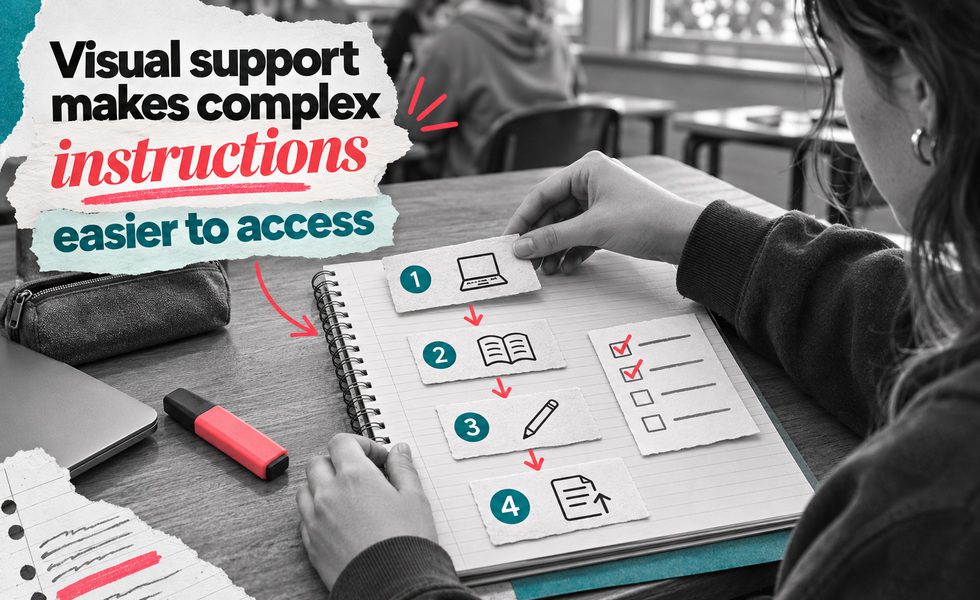
Missing one step does not mean the student ignored the teacher. Written instructions, a short checklist or one step at a time can reduce the memory load without simplifying the learning goal.
Some instructions are implied
Teachers do not always state every step. “You might want to look at question three again” can mean “There is an error; check and change your answer.”
“Use your time wisely” may require a student to infer which task to begin, how long to spend and what finished work should look like.
Students who interpret language directly may understand the words but miss the intended action. Direct communication is not an inferior style. Making expectations explicit benefits many students and reduces the need to guess.
Classroom discussion moves quickly
During discussion, a student may need to follow several speakers, understand new information, recognise humour or disagreement, decide when to enter the conversation and prepare a response. By the time their answer is organised, the class may have moved to another point.
This can create a misleading picture. A student who says little may have relevant ideas. Another may contribute confidently but lose track when the topic changes. Participation should not be measured only by fast verbal responses.
Useful options include giving discussion questions in advance, allowing brief planning time, using think-pair-share, accepting written contributions and summarising key points before moving on.
Explaining and justifying answers takes language
Knowing a fact and explaining why it matters are different tasks. High school students are frequently asked to compare, argue, interpret and support a position with evidence.
They must select relevant information, organise it, use connecting words and consider what the listener or reader already knows.
A teenager may produce a short answer that does not reflect the depth of their understanding. They may also include many accurate ideas without a clear structure. Planning frameworks, sentence starters and worked examples can reveal the hidden structure of a response.
For example, “justify your answer” can be unpacked as:
- state your answer;
- give a reason;
- include relevant evidence;
- explain how the evidence supports the reason.
This is access support, not giving away the answer.
Knowing the content is not the same as processing the language
Parents and teachers may see a puzzling pattern: the student can demonstrate knowledge in conversation at home, in a practical task or when discussing a strong interest, yet struggle with worksheets, examinations or on-the-spot questions.
The difference may be the language load. A task can require reading comprehension, vocabulary, verbal memory, inferencing, planning and writing in addition to subject knowledge. When these are all assessed at once, it can be difficult to see what the student actually understands.
Looking at where and how performance changes can be more informative than asking whether a teenager is “capable”.
What happens when the instruction is written? When key words are explained? When planning time is provided? When the student can type instead of speak? These observations can guide useful adjustments.

How language demands can affect participation
Persistent difficulty accessing classroom language can affect more than marks. A student may hesitate to ask for help, avoid group work, copy what others are doing or appear to switch off.
They may expend considerable energy trying to keep up and have less capacity left for homework or social communication.
Support should not require a teenager to disclose personal information repeatedly or explain their needs perfectly. Adults can create predictable ways to request clarification, ask privately what helps and check that agreed adjustments are actually available across subjects.
Practical support for families and educators
The following strategies are practical options rather than a universal checklist:
- pair spoken explanations with written key points;
- break long instructions into visible steps;
- teach command words and subject vocabulary explicitly;
- provide examples of finished work and explain why they meet the task;
- allow processing and planning time before expecting a response;
- check understanding by asking the student to show the first step, rather than asking only “Do you understand?”;
- provide planning tools for oral and written responses;
- offer appropriate choices for demonstrating knowledge, such as speaking, typing, visuals or AAC;
- reduce unnecessary figurative or ambiguous language when giving essential instructions;
- involve the teenager in reviewing what support is useful and respectful.
The NSW Department of Education’s Universal Design for Learning guidance emphasises multiple ways to represent information and multiple ways for students to act and express what they know.
These principles can reduce barriers across the whole classroom, while individual students may also need personalised adjustments.
How a speech pathologist can help
Speech pathology for teenagers can address much more than speech sounds. A speech pathologist may explore understanding of spoken and written language, vocabulary, sentence structure, inferencing, narrative, classroom discourse and organisation of responses.
Support can be linked to real goals: understanding task words, planning an assignment, following practical instructions, contributing to discussion or asking for clarification.
Collaboration with the student, family and school helps ensure strategies work in actual classrooms rather than only in a clinic activity.
The teenager’s perspective matters. Therapy and adjustments should support access, participation and self-advocacy, not pressure them to appear more typical or communicate in one acceptable way.
When to seek professional guidance
Consider seeking advice when a teenager regularly understands less than expected from spoken information, struggles to explain what they know, needs much more support than peers to begin language-heavy tasks or experiences a marked difference between practical knowledge and classroom performance.
It may also be useful to review support during the transition to high school, subject changes or increasing assessment demands.
A speech pathologist can help clarify the language component and discuss whether assessment, classroom adjustments or targeted intervention may be appropriate.
Make the language of learning visible
High school is not simply primary school with more homework. The language becomes denser, faster and more abstract.
When adults make instructions, vocabulary and response structures visible, students have a fairer opportunity to access the curriculum and show their thinking.
If you would like to discuss language support for a pre-teen or teenager in Sydney, Bondi Junction or the Eastern Suburbs, contact Speakable Speech Pathology.
Frequently asked questions
Why does my teenager understand a subject but struggle with assignments?
Assignments often add language demands such as interpreting command words, organising ideas, explaining evidence and writing for a reader. These demands can make it harder to demonstrate subject knowledge.
What does language processing mean?
Language processing describes how a person takes in, understands, organises and responds to language. It is not a measure of intelligence, and processing may change with context, stress, fatigue and task complexity.
Can a speech pathologist help with high school learning?
Yes. Speech pathologists can support the language skills involved in understanding instructions, learning vocabulary, discussing ideas, reading comprehension and written expression. Goals should connect with the student’s priorities and school participation.
What classroom adjustments may help?
Helpful adjustments may include written instructions, explicit vocabulary teaching, visual planning tools, processing time, worked examples and flexible response formats. The best combination depends on the individual student.
Is asking for clarification a skill that can be supported?
Yes. Students can develop comfortable ways to check information, request repetition or explain what part is unclear. Schools can also make help-seeking more accessible and less public.