
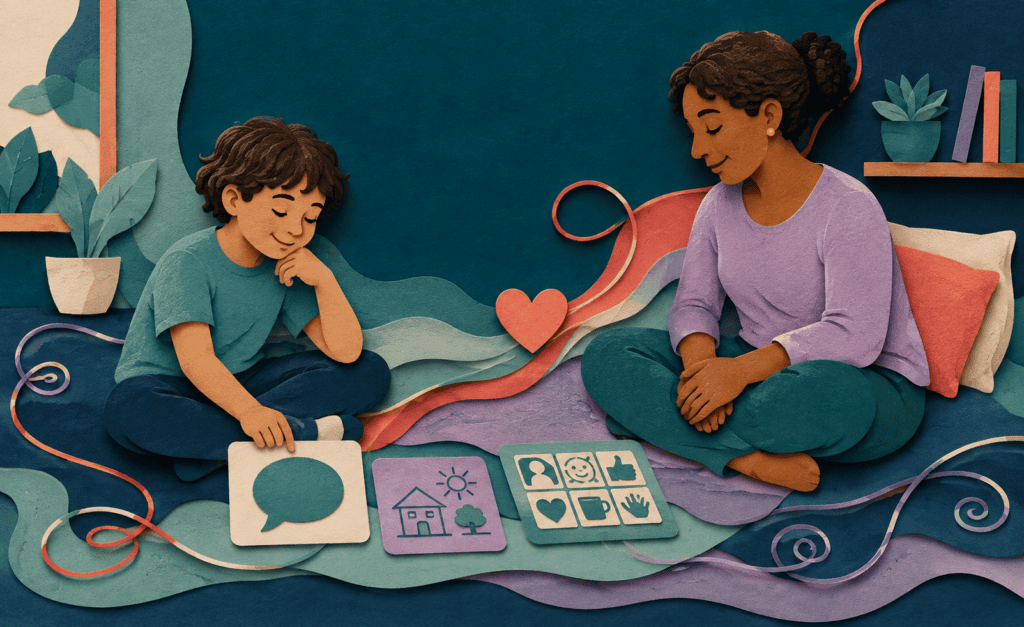
Communication Is Good for Mental Health
A child comes home from school looking upset. An adult asks, “What happened?”
The child says, “Nothing.”
That answer might mean many things. Perhaps nothing unusual happened. Perhaps the child needs time before talking. Perhaps they know something felt wrong but cannot yet organise it into words. They might be worried about how the adult will react, unsure which detail matters or too overwhelmed to explain.
Communication is often described as the ability to speak clearly or use the right words. In everyday life, it is much broader. Communication helps children understand what is happening, share an idea, express discomfort, ask for help, set a boundary, repair a misunderstanding and connect with other people.
These experiences matter for mental health and emotional wellbeing.
This does not mean that strong communication skills prevent mental health difficulties, or that a communication difficulty causes anxiety or depression. The relationship is more complex. Speech, language, communication, relationships, learning, sensory experiences, identity, health and environment can all interact.
It does mean that making communication more accessible can give children more ways to be understood, participate and reach support when they need it.
Communication is more than talking about feelings
When adults hear “communication and mental health”, they may picture a child naming emotions or having a long conversation about their day. Those skills can be useful, but they are only part of the picture.
Communication that supports wellbeing may include being able to:
- understand what is expected and what will happen next;
- tell someone that a noise, task or interaction feels too much;
- ask for clarification, more time, a break or another form of support;
- share an interest and experience enjoyment with another person;
- recognise and communicate a preference;
- say “no”, “stop” or “I don’t want to talk yet”;
- explain a problem after having time to process it;
- join a friendship or community in an authentic way;
- and contact a trusted person or service when help is needed.
Children may do this through speech, sign, gesture, facial expression, body movement, drawing, writing, pictures, AAC or a combination of forms. A child who cannot describe an emotion in a complete spoken sentence may still communicate clearly by moving away, choosing an image, typing a message or showing an adult what happened.
The goal is not to make every child communicate in the same way. It is to make sure their communication is noticed, respected and accessible.
Speakable’s article Why Some Children Understand More Than They Can Say explores why a quick spoken response may not show the full depth of a child’s understanding.
Feeling understood can change the experience
Imagine knowing that something is wrong but not having an effective way to explain it. An adult asks several questions. Classmates are waiting. The words do not come quickly enough. Someone guesses incorrectly, and correcting them feels even harder.
In that situation, the communication demand can become another source of stress.
Now imagine that the adult says:
“You don’t have to explain it all right now. You can tell me, show me, write it, or we can come back to it later.”
The problem itself has not disappeared. But the child has been given time, options and evidence that their message is worth waiting for.
Emerging Minds explains that clear, age-appropriate communication can help children make meaning of what is happening around them. Regular, open communication can also build trust and strengthen connection. Importantly, good communication does not mean telling a child everything or requiring them to talk at length. It involves listening, being clear and considering what the child can understand at that moment. See Communication and meaning-making: why good communication is key to children’s mental health.
Feeling understood is not the same as having every problem solved. Sometimes the most supportive response is simply:
“That makes sense.”
“I’m glad you told me.”
“Would you like help, or would you like me to listen?”
These responses show the child that communication can lead to connection rather than correction, disbelief or immediate pressure.
Why communication difficulties and mental health can overlap
Speech Pathology Australia describes the relationship between communication needs and mental health as complex and multifactorial. Communication difficulties and mental health concerns may occur together, and unmet communication needs can affect areas such as relationships, education, participation and access to services. Its submission on the National Children’s Mental Health and Wellbeing Strategy also notes that communication disability may be missed or misinterpreted as behaviour.
There are several practical reasons these areas can overlap.
Repeated misunderstandings can be tiring
A child may know what they want to say but be unable to retrieve the word, organise the story or produce the speech sound clearly under pressure. They might repeat themselves, simplify the message, give up or let someone else speak for them.
One misunderstanding is part of ordinary communication. Repeated experiences of not being understood, being corrected publicly or having intentions misread can make communication situations feel less safe.
The answer is not to avoid every challenge. It is to provide enough support for the child to communicate without unnecessary shame or pressure.
Language demands can hide inside everyday situations
A classroom instruction, friendship disagreement or mental health appointment can all involve complex language. The child may need to:
- understand abstract vocabulary;
- identify the sequence of events;
- separate thoughts, feelings and actions;
- work out what the listener already knows;
- find precise words;
- answer unexpected questions;
- and process another person’s response.
A child who says “I don’t know” may not be refusing to engage. They may need the question made more concrete, more processing time or another way to respond.
Participation and belonging matter
Relationships, friendships and community connections are important parts of children’s mental health, according to the Raising Children Network’s guidance on good mental health for children.
Communication can support belonging, but belonging should not depend on performing a narrow version of social behaviour. Some children enjoy long conversations. Others connect through a shared activity, parallel play, humour, exchanging facts, gaming, movement, art or quiet companionship.
Support should help the child access relationships that are meaningful to them. It should not require forced eye contact, scripted friendliness, suppression of natural movement or masking of communication differences.
Speakable’s The Language of Friendship: How Communication Shapes Social Confidence looks more closely at the communication involved in joining, maintaining and repairing friendships.
Asking for help is a communication task
Seeking support can require a child or teenager to notice a problem, decide whom to trust, begin the conversation and explain enough for the other person to respond.
That is a demanding sequence, especially when the young person is distressed.
A child may need an accessible phrase, card, message template, AAC pathway or agreed signal. They may also need adults to notice changes and open the conversation without demanding an immediate explanation.
For teenagers, self-advocacy might sound like:
“I need you to ask one question at a time.”
“I can explain this better in writing.”
“I’m not feeling safe.”
“I want another person with me for this conversation.”
These are communication skills with real implications for wellbeing and access to care.
What supportive communication looks like at home
Parents do not need to turn every emotion into a lesson. Small changes in everyday interaction can make it easier for a child to communicate.
1. Make space without forcing disclosure
An invitation to talk is different from an interrogation.
Headspace recommends choosing a time when the adult feels calm and open to listening, paying attention to tone and body language, and considering settings such as a walk or drive because some young people prefer not to talk face to face. Its guide, How to start a mental health conversation, also emphasises listening carefully and taking the young person’s feelings seriously.
Try:
“You seem quieter than usual. I’m here if you want company or want to tell me anything.”
“Would it be easier to talk now, later or by message?”
“You can tell me one part. You don’t have to explain everything at once.”
If the child says they do not want to talk, the adult can respect that boundary while keeping support available. If there is an immediate safety concern, the adult may still need to seek urgent professional help.
2. Reduce the language load when emotions are high
During distress, long explanations and repeated questions may be difficult to process. Use clear, manageable language and pause.
Instead of:
“Why did you do that when we have talked so many times about what you should do if someone bothers you?”
Try:
“You’re safe with me. We can work out what happened when you’re ready.”
When choices are useful, keep them genuine and limited:
“Do you want quiet, a hug or some space?”
Do not assume that every child can choose in that moment. A familiar visual, gesture or routine may be easier than spoken options.
3. Accept different forms of communication
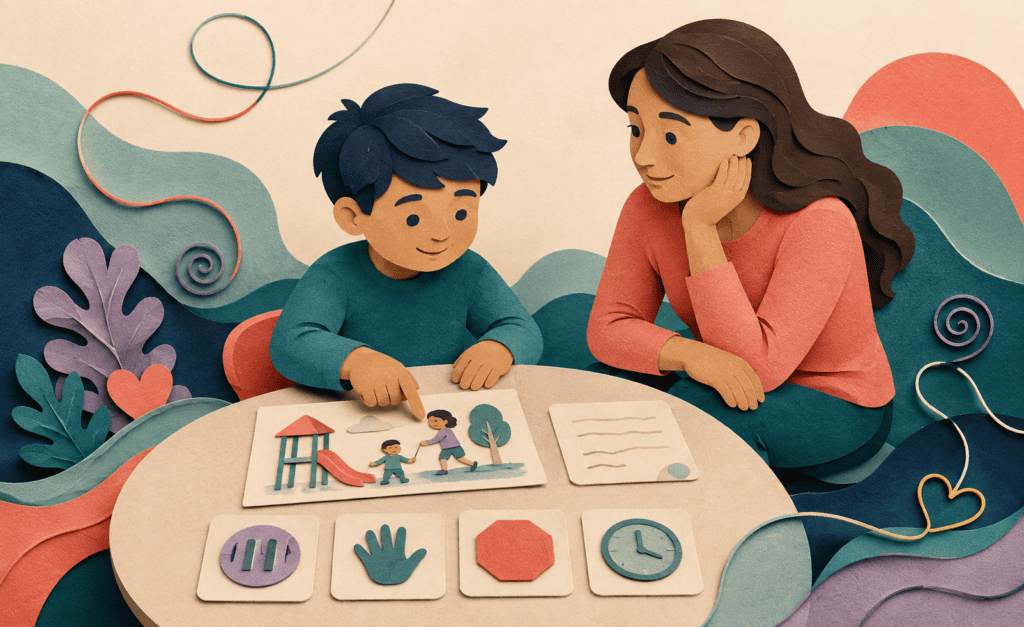
A child might draw the playground, point to the person involved, act out the event with toys, select emotion words, write in a notebook or send a text from another room.
These are not lesser versions of communication. They may help the child organise the message and participate more accurately.
AAC should remain available during emotional conversations. It is not only for requesting objects. A child may need vocabulary for feelings, people, places, pain, consent, disagreement, privacy and help.
4. Comment before asking questions
Questions have a purpose, but too many can make a conversation feel like a test.
Try a comment that gives the child something to respond to:
“That looked disappointing.”
“I noticed the plan changed suddenly.”
“It sounds like there were a lot of people talking at once.”
The child can agree, correct, add information or say nothing. A pause after the comment creates room without demanding a performance.
5. Model language without deciding the feeling for them
Emotion words can help children make distinctions, but adults do not always guess correctly.
Try:
“I wonder if that felt frustrating, confusing or something else?”
“Your body looks tense. I don’t know what you’re feeling yet.”
This offers language while leaving the child as the authority on their own experience.
Some children identify physical sensations more easily than emotion labels. They might notice a tight jaw, hot face, heavy body, fast heartbeat or urge to leave. That information can still help them recognise what support they need.
6. Teach language for boundaries and repair
Communication that supports mental health includes more than being polite or keeping a conversation going. Children need ways to protect themselves and repair interactions.
Useful messages might include:
- “Stop.”
- “I don’t like that.”
- “I was not finished.”
- “That is not what I meant.”
- “Please explain it another way.”
- “I need more time.”
- “Can you come with me?”
- “I want to try again.”
The exact form should suit the child. It might be spoken, signed, selected on AAC, shown on a card or sent as a message.
7. Repair your own communication too
Adults misunderstand, interrupt, react too quickly and use the wrong words. Repairing these moments can show children that communication does not have to be perfect to remain safe.
An adult might say:
“I answered before I understood. Let me try again.”
“I thought you wanted advice, but you wanted me to listen.”
“My voice was too loud. I’m sorry.”
Repair is not a failure of communication. It is part of communication.
Communication support should not become pressure to appear fine
A child may use fluent language and still be struggling. Another child may communicate very little in a particular setting and still have clear thoughts, preferences and awareness.
Adults can miss distress when they rely on one expected presentation.
For example, a child might:
- agree automatically even when they do not understand;
- copy peers to avoid attention;
- use humour to move away from a difficult topic;
- give a rehearsed answer such as “I’m fine”;
- speak extensively about facts but find personal experiences harder to explain;
- communicate more freely at home after remaining quiet all day;
- or show stress through changes in sleep, participation, eating, play, movement or tolerance for everyday demands.
These signs do not identify a particular diagnosis. They are reasons to stay curious, compare observations and consider whether the child needs more support.
A neurodiversity-affirming approach does not measure success by how typical or cheerful a child appears. It values authentic communication, autonomy, consent and access. Speakable’s article Neurodiversity-Affirming Therapy: Supporting Different Ways of Thinking & Communicating explains how therapy can support real needs without treating difference itself as the problem.
How a speech pathologist can contribute
Speech pathology is not mental health treatment. A speech pathologist does not replace a psychologist, psychiatrist, GP or other mental health professional.
A speech pathologist can, however, help identify and reduce communication barriers that affect everyday participation or access to care. Depending on the child, support may include:
- understanding questions and emotional vocabulary;
- organising an explanation or personal narrative;
- building reliable ways to ask for help, refuse or request a break;
- supporting speech clarity without shame or pressure;
- developing self-advocacy language;
- expanding AAC for emotions, consent, relationships and safety;
- preparing for an appointment or unfamiliar conversation;
- helping families, schools and other professionals adjust their communication;
- and recognising when another professional’s input is needed.
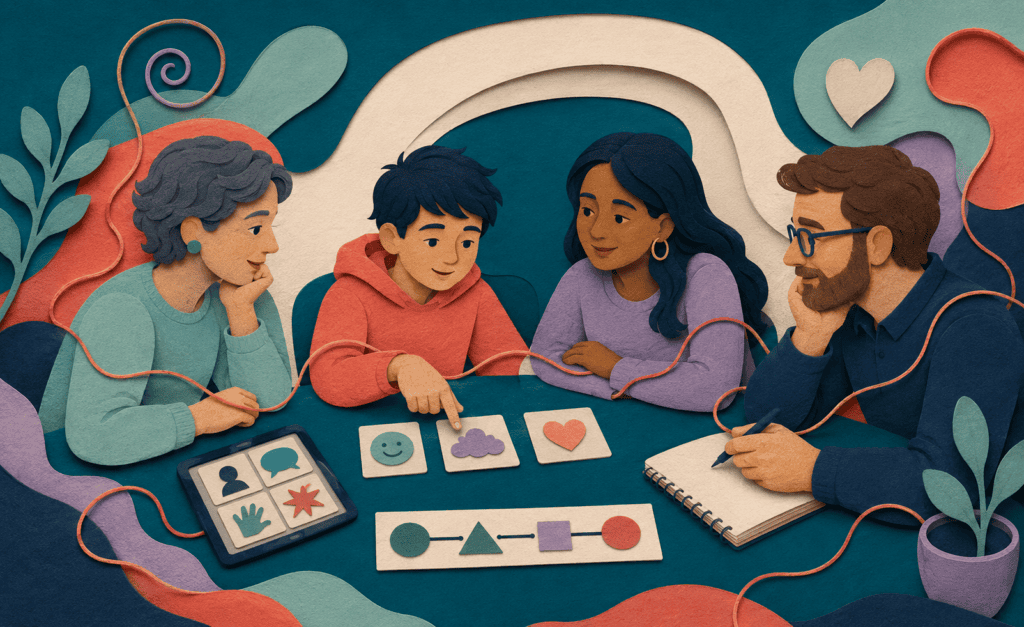
Collaboration matters. A psychologist may need to know that a young person finds open-ended questions difficult. A teacher may need a practical way for the child to signal overwhelm. A speech pathologist may need to understand when and where distress is occurring. Information should be shared with appropriate consent and in line with professional and organisational requirements.
The purpose is not to make the child responsible for communicating perfectly before adults respond. Adults and environments also need to become more accessible.
When to seek additional support
All children have difficult days and periods when they communicate less. Consider speaking with a GP or qualified mental health professional when changes are persistent, increasing or affecting the child’s daily life.
The Raising Children Network advises families to pay attention when changes in thoughts, feelings or behaviour last and begin to affect areas such as home, school or relationships.
Examples that warrant closer attention may include ongoing withdrawal, intense worry, lasting sadness or irritability, significant changes in sleep or eating, avoiding school or previously valued activities, or comments about hopelessness, self-harm or not wanting to be alive.
If communication itself is regularly difficult — for example, the child struggles to understand language, organise experiences, express needs, use speech clearly or access a reliable communication system — a speech pathology assessment may also be useful. Some children need support from both communication and mental health professionals.
If a child or young person may be in immediate danger, call Triple Zero (000) or go to the nearest emergency department. For current Australian crisis and mental health contacts, see Healthdirect’s “Need help now” page.
Support options include:
- Kids Helpline: 1800 55 1800 — free, private and confidential phone and webchat counselling, 24/7, for young people aged 5–25. See Kids Helpline.
- Lifeline: 13 11 14 — crisis support available 24/7. See Lifeline.
- eheadspace: 1800 650 890 or online support — for young people aged 12–25 and their families. Current contact options and hours are available on eheadspace.
Communication can create a pathway to connection and support
Communication is not a test of how confidently, quickly or typically a child can speak.
It is the shared process through which a child can understand, participate, connect, disagree, ask, refuse, explain and seek help.
Supporting that process may mean developing language skills. It may also mean changing how adults listen, reducing pressure, using clearer language, waiting longer, offering AAC, accepting writing or drawing, creating predictable ways to ask for help and taking a child’s communication seriously.
These changes cannot promise good mental health or remove every difficulty. They can make it easier for a child to be known, to influence what happens around them and to reach another person when something is wrong.
That is why communication belongs in conversations about wellbeing.
If you are concerned that speech, language or communication barriers are affecting your child’s confidence, relationships or access to support, contact Speakable to discuss whether a speech pathology assessment may be appropriate.