

Why Great Outcomes Happen When Parents, Teachers & Therapists Work Together
A child gives very short answers in class but talks in detail about the same topic at home. In a speech pathology session, they explain more when they can draw first or use a visual organiser.
Which version shows what the child can really do?
All of them.
Communication changes with the setting, the people, the task, the amount of time available and the support around the child. No single adult sees every part of the picture.
Parents and carers know the child’s history, interests, culture, routines and everyday communication. Teachers see how the child manages classroom language, curriculum tasks, friendships and group expectations. Speech pathologists can explore specific communication skills and help the team understand what makes participation easier or harder.
When these perspectives come together, support can become more relevant and easier to use. A therapy goal can connect with an actual classroom demand. A strategy that works at school can be adapted for home. A parent’s observation can help explain a pattern that was not visible during an assessment.
Collaboration does not mean that everyone must use identical activities or agree immediately about every detail. It means sharing useful information, listening to the child and one another, and working towards priorities that matter in the child’s life.
Because Speakable is a speech pathology service, therapist in this article refers mainly to a speech pathologist. Other relevant allied health professionals may also be part of a child’s team.
One setting never tells the whole story
Children do not communicate in exactly the same way everywhere.
A quiet one-to-one therapy room may reduce background noise and give the child more processing time. A classroom may involve rapid instructions, unfamiliar vocabulary, group discussion, written work and frequent transitions. At home, the child may have familiar communication partners, preferred interests and more freedom to move or pause.
These differences do not make one person’s observation more accurate than another. They provide clues about the conditions in which the child communicates most comfortably and effectively.
For example:
- a child who follows instructions in therapy but not in class may be managing a much heavier language and sensory load at school;
- a child who speaks at home but rarely contributes in a group may need more time, predictability or another way to participate;
- a child who uses a strategy during a structured session but not in everyday life may need the strategy adapted, practised in context or made easier to access;
- a child who appears to understand a lesson but cannot explain their answer quickly may need visual structure or an alternative way to demonstrate knowledge.
Speakable’s article Why Some Children Understand More Than They Can Say explores why spoken answers do not always show the full depth of a child’s understanding.
When adults compare what they notice across settings, the question can shift from “Why won’t the child do this?” to “What changes the communication demand, and what support helps?”
What each person brings to the team
Strong collaboration is not about handing responsibility to the person with the most qualifications. It works best when different kinds of expertise are valued.
Parents and carers bring knowledge of the whole child
Families often know:
- how the child communicates when relaxed, tired, excited or overwhelmed;
- which interests, routines and relationships are meaningful;
- what has helped or caused distress in the past;
- which languages and communication styles are used at home;
- what the child says about school when school staff are not present;
- and which goals would make the greatest difference to daily family life.
This information cannot always be captured by a formal assessment. A parent might notice that their child explains events more clearly while drawing, understands instructions better after seeing an example or uses AAC more independently with a sibling than with an unfamiliar adult.
Teachers bring knowledge of learning and participation
Teachers see communication within the curriculum and the wider school day. They may notice how the child:
- follows whole-class and multi-step instructions;
- learns and recalls new vocabulary;
- organises spoken and written ideas;
- joins group work or playground interactions;
- asks for clarification or help;
- copes with transitions and unexpected changes;
- and demonstrates knowledge under time pressure.
Teachers also know the practical realities of the classroom. A recommendation is more useful when it can fit the lesson, be understood by relevant staff and support participation without unnecessarily separating the child from peers.
Speech pathologists bring communication expertise
A speech pathologist can assess and support areas such as speech, receptive and expressive language, literacy, fluency, voice, social communication and AAC, depending on the child’s needs.
They can help the team connect an everyday observation with the communication demands involved. “They forget the task” might involve the length of the instruction, unfamiliar concepts, working-memory load or difficulty asking for repetition. “They know it but cannot write it” might involve vocabulary, sentence structure, narrative organisation, literacy or the way the task is presented.
Speakable’s Speech Pathology for Children page explains that individual programs are designed with input from parents, teachers and family members.
The child brings essential knowledge too
The child is not the subject of the team; they are part of it.
Children may be able to show or tell adults:
- what feels easy or difficult;
- which support is useful, embarrassing, tiring or distracting;
- what they want to learn or participate in;
- who they feel comfortable asking for help;
- and how they prefer to communicate.
The child’s contribution may be spoken, signed, written, drawn, selected from choices or expressed through AAC. Younger children and children who do not yet communicate a detailed opinion still show preferences through their engagement, refusal, body language and choices.
A neurodiversity-affirming plan respects these signals. It does not treat compliance, eye contact or appearing indistinguishable from peers as the outcome. Speakable’s article What It Really Means to Be a Neurodiversity-Affirming Clinic discusses child-centred goals, consent and multiple valid forms of communication.
Why collaboration can improve the usefulness of support
The NSW Department of Education’s Stronger together: family, school and speech pathologist resource recommends that families, schools and speech pathologists share observations, concerns, strategies and goals. It also gives examples such as discussing classroom adjustments, sharing relevant learning content and connecting therapy work with home and school.
This kind of collaboration can improve support in several practical ways.
Goals become connected with real participation
A broad goal such as “improve expressive language” may be difficult for a family or teacher to apply. A shared functional priority is clearer:
“The child will have an accessible way to explain a problem and ask for help during independent classwork.”
The speech pathologist might help develop a short visual framework. The teacher might make it available during relevant lessons. The family might use the same structure when the child wants help with a game or homework. The wording and level of support can change across settings while the purpose remains connected.
Strategies are tested where they are needed
A strategy can work well in a quiet session and still need adjustment in a busy classroom. Teacher feedback helps identify practical questions:
- Can the child find the visual when they need it?
- Does it work during whole-class instruction as well as one-to-one support?
- Is the language brief enough?
- Can the child use it without waiting for an adult prompt?
- Does the support help, or does it add another task?
The speech pathologist can then refine the recommendation. The family can explain whether a similar approach feels manageable at home.
Progress is understood more broadly
Clinic data can show whether a child is learning a skill under structured conditions. Home and school observations can show whether that skill is becoming useful in everyday communication.
Progress might look like:
- asking for clarification before becoming overwhelmed;
- contributing one idea to a group in a preferred form;
- using a visual sequence with less adult support;
- explaining what went wrong after having time to organise the message;
- participating in a literacy task with an appropriate adjustment;
- or feeling safer telling an adult that something is too difficult.
These changes may be more meaningful than completing a worksheet perfectly.
Adults can respond more consistently
Consistency does not mean making home, school and therapy look the same. It means avoiding messages that work against one another.
For example, if the agreed aim is to support self-advocacy, the adults might all respond positively when the child asks for more time. At home the child might say, “Wait”. At school they might show a card. In therapy they might select a phrase on AAC. The form can vary while the communicative purpose is respected.
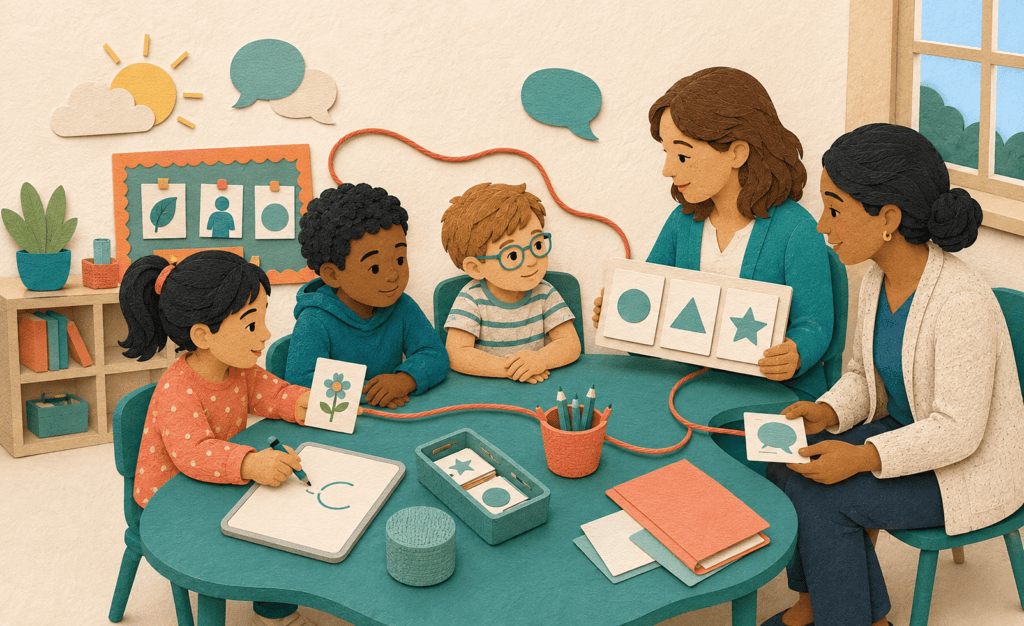
What effective teamwork looks like in practice
The Australian Government’s Family–School Partnerships Framework describes parent engagement as an intentional, collaborative approach that uses the knowledge and capacities of families to support learning and wellbeing. ACECQA’s guidance on building partnerships with families similarly emphasises valuing each other’s knowledge, communicating respectfully and sharing decisions.
In day-to-day practice, effective teamwork can be surprisingly simple.
1. Begin with one shared priority
Teams do not need to address every concern at once. Choose a priority that matters to the child and affects participation.
Examples include:
- understanding the morning classroom routine;
- explaining an idea during writing;
- joining a preferred lunchtime activity;
- asking for a break or clarification;
- using AAC across more than one setting;
- or repairing a misunderstanding with familiar communication partners.
Ask: “What would become easier or more accessible if this support worked?”
2. Describe what is observed, not what is assumed
Compare:
“She is not motivated to speak in class.”
with:
“During whole-class questions, she often looks down and does not answer. When given the question on paper and two minutes to prepare, she writes a response and shares it with the teacher.”
The second description gives the team information they can use. It avoids assigning an intention to the child and identifies conditions that may change participation.
3. Use plain, shared language
Professional terms can be useful, but everyone needs to understand what the plan means in practice. If a report says “reduce receptive language load”, the team might translate this into:
- give one step at a time;
- show the step as well as saying it;
- pause before repeating;
- and check understanding without asking only, “Do you understand?”
Families should feel comfortable asking for an explanation. Teachers should be able to explain what is realistic in the classroom. Speech pathologists should know when a strategy is unclear or difficult to implement.
4. Keep strategies small and specific
A long list is easy to lose. Begin with one or two actions, identify when they should be used and decide who needs to know.
| Shared priority | Small strategy | Where it can be used | What the team will notice |
|---|---|---|---|
| Ask for clarification | Model and make available “Please say that another way” in the child’s preferred communication form | Classroom, home and therapy | Whether the child can access it before frustration increases |
| Organise an explanation | Use a three-part visual: what happened, what I tried, what I need | Writing tasks, homework and problem-solving | Whether explanations become easier to follow with less prompting |
| Join group learning | Preview the topic and offer a choice of speaking, showing, writing or using AAC | Selected group activities | Whether the child contributes in an accessible form |
The plan should be individualised. These examples are not a substitute for assessment or advice from the child’s team.
5. Choose a manageable communication method
Collaboration does not require frequent formal meetings. Depending on the school and family, communication might include:
- a brief email update;
- one shared page summarising the goal and strategies;
- a scheduled phone or video call;
- a report sent to the school with parent or carer consent;
- a learning and support meeting;
- or a short review at an agreed point in the term.
Decide what information is useful, how often it is needed and who will receive it. Sharing should follow parent or carer consent and the relevant school and clinic processes.
For students with disability, the Australian Government notes that education providers must consult regularly with students and their parents or caregivers when developing reasonable adjustments and addressing concerns. Its resources for educators on the Disability Standards for Education provide further information about these obligations.
6. Review whether the support is helping
Set a realistic time to check:
- What has become easier?
- When is the strategy being used?
- Does the child find it useful?
- Is the adult prompting more than expected?
- Is there a context where it does not work?
- Should the goal, strategy or environment change?
If progress is different across settings, that is useful information rather than evidence that someone has failed.
A practical example: from three separate concerns to one shared plan
Imagine a primary school-aged child who often leaves written tasks unfinished.
The teacher notices that the child spends a long time looking at the page and frequently copies the first sentence from the board. The family reports that the child understands the topic at home and can explain detailed ideas while building with blocks. The speech pathologist observes that the child has difficulty organising an oral explanation quickly but communicates more clearly with a simple visual sequence.
If each person works separately, the child might receive more writing practice, more questions at home and a therapy activity that does not reach the classroom.
Working together, the team could decide that the immediate priority is helping the child organise and demonstrate an idea. They might:
- allow planning through drawing, keywords or AAC before writing;
- use the same simple sequence for selected classroom and home tasks;
- reduce the amount of copying required;
- give the child time to prepare before sharing;
- and review whether the support increases participation and reduces frustration.
The child is not being asked to communicate in one “correct” way. The team is making the route into the task more accessible.
Speakable’s article From Therapy Room to Classroom: Bridging Language and Learning looks further at connecting communication support with school demands.
Common barriers — and ways to make collaboration more realistic
“Everyone is too busy”
Time is a genuine constraint for families, teachers and clinicians. Prioritise the smallest exchange that would change the support: one current goal, two strategies and one review date. A concise summary may be more usable than a long stream of messages.
“The advice from different people conflicts”
Ask what each recommendation is trying to achieve. Two approaches may suit different contexts, or the team may need to choose one strategy to trial. If a recommendation causes distress, reduces access or is not feasible, bring that information back to the team.
“The report is too technical”
Ask for a plain-language explanation and examples. Useful recommendations should tell the reader what to do, when to do it and what difference to look for.
“My child behaves differently at home and school”
This is common and does not mean that one adult is mistaken. Consider communication load, predictability, sensory demands, relationships, fatigue and the supports already available in each setting.
“I do not want to be seen as difficult”
Sharing a specific observation or asking a question is part of collaborative planning. Try:
“We have noticed that drawing first helps at home. Is there a classroom task where we could test whether that support is useful?”
“Could you show me what this strategy would look like during a typical lesson?”
“What should we notice before the next review?”
Families can also ask for an interpreter if this would make participation in a meeting or discussion more accessible.
Questions that can help the team move forward
Before a conversation with the school or speech pathologist, choose the questions that matter most:
- What does the child say is important or difficult?
- What strengths and interests can support this goal?
- What have we each observed, and in which setting?
- What already helps?
- What is the communication or learning demand in this situation?
- What is one shared priority for the next few weeks?
- What will the strategy look like at home, school and therapy?
- Does the child have an accessible way to accept, refuse or comment on the support?
- Who needs this information, and has consent been provided to share it?
- When will we review whether the plan is useful?
The purpose is not to produce a perfect plan in one meeting. It is to create a clearer next step and keep the child’s participation at the centre.
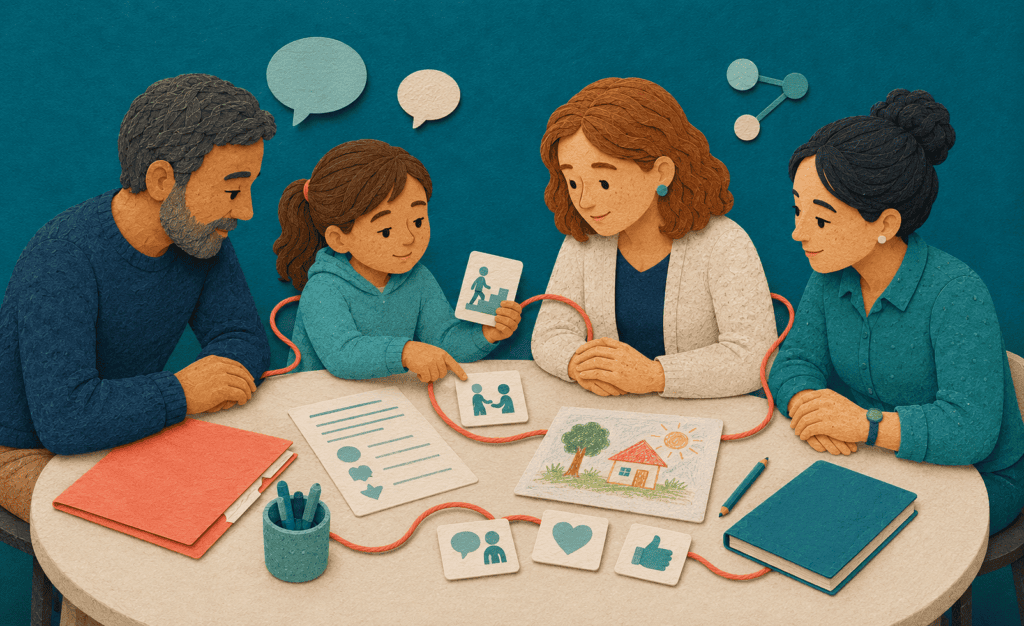
Great outcomes grow from shared understanding
The strongest team is not necessarily the one that meets most often. It is the one that combines information respectfully and turns it into support the child can actually use.
Parents and carers bring knowledge of the child across time and relationships. Teachers bring the learning environment and curriculum context. Speech pathologists bring communication expertise. The child brings their own priorities, preferences and experience.
When these perspectives connect, adults can move beyond isolated exercises and assumptions. They can create goals that matter, strategies that fit, and more accessible opportunities for the child to communicate, learn and participate.
Collaboration cannot promise a particular result. It can, however, give the team a fuller picture and a more practical way to respond.
If you would like support connecting your child’s speech, language, literacy or communication goals across home and school, contact Speakable to talk with the team.