

Beyond Speech: How AAC Tools and Devices Support Communication From Childhood to Adolescence
Communication is about much more than spoken words.
We communicate to make choices, ask questions, tell stories, share opinions, connect with other people, disagree, joke, learn and advocate for ourselves.
For some children and young people, Augmentative and Alternative Communication (AAC) can provide additional ways to do all of these things.
AAC may be used alongside speech or as a person’s primary way of communicating. And just as communication changes as children grow, the tools and support they use may change too.
AAC is more than a device
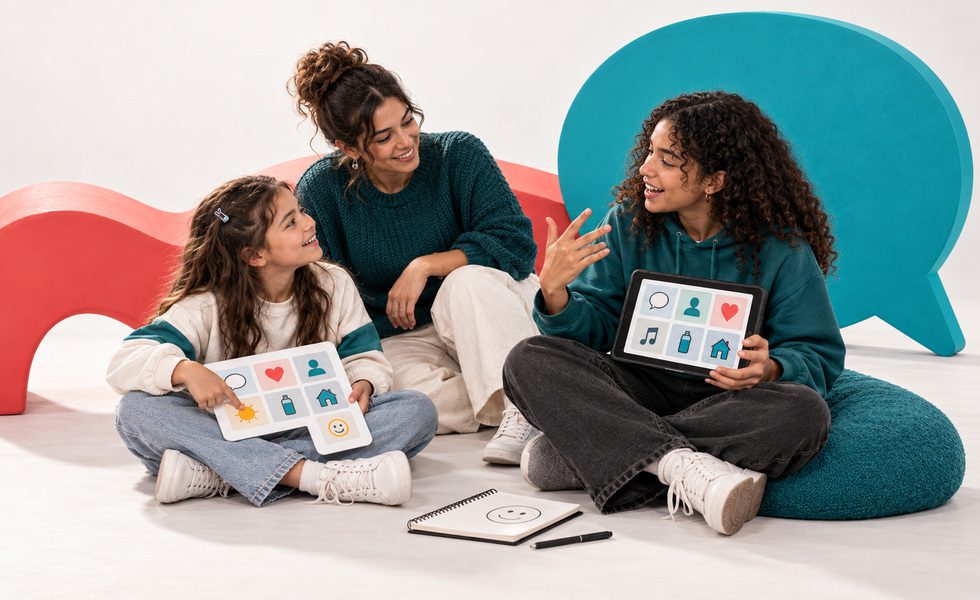
When people hear the term AAC, they sometimes think immediately of a tablet or speech-generating device.
But AAC includes many different ways of communicating.
It can include:
- gestures and body movements
- facial expressions
- signs
- communication boards
- communication books
- pictures and symbols
- written words
- apps
- speech-generating devices
A person may use several of these methods together.
For example, a child might point to a symbol while using a vocalisation. A teenager might use speech in some situations, type a message in another, and use an AAC device when they need more support to communicate clearly.
The goal is not to make communication fit one particular method. It is to help each person have reliable ways to express what they want to say.
Communication grows with the child
The things children want and need to communicate do not stay the same.
A younger child may use AAC to choose between activities, ask for a favourite toy, say “no”, ask for help or tell someone that something has happened.
As they move through primary school, communication becomes increasingly connected to learning and relationships.
They may need ways to:
- ask and answer classroom questions
- contribute to group activities
- tell longer stories
- explain what happened
- comment on what other people say
- talk with friends
- express preferences and opinions
By adolescence, communication demands can become even more complex.
Teenagers may want to discuss friendships, negotiate plans, explain an assignment, participate in group work, tell jokes, express disagreement, talk about their interests or make decisions about their own lives.
AAC needs to be able to support real communication, not only requests.
AAC can support participation, not just asking for things
Learning to communicate “I want…” can be useful, but communication is much bigger than requesting.
Children and teenagers also need opportunities to:
Comment:
“That was funny.”
Ask questions:
“Why did that happen?”
Share opinions:
“I don’t agree.”
Tell stories:
“Guess what happened at school today?”
Connect socially:
“Do you want to sit with us?”
Advocate for themselves:
“I need more time.”
Repair misunderstandings:
“That isn’t what I meant.”
These everyday interactions matter because communication is closely connected to participation, relationships and autonomy.
A robust communication system therefore needs room for more than basic wants and needs. It needs to grow with the communicator.
The right AAC may look different at different ages
There is no single AAC system that suits every person.
The most useful tools depend on the individual, their communication needs, their environments and the people they communicate with.
A system that works well for a young child may need to change as vocabulary expands, interests change and school demands become more complex.
This does not necessarily mean replacing everything.
Sometimes it means adding vocabulary, changing how information is organised, improving physical access, introducing different tools for different situations or making sure the system remains available across home, school and community settings.
What matters is that the person can access meaningful communication as their life changes.
Communication partners are part of communication access
AAC access does not depend only on the person using AAC.
The people around them matter too.
Parents, carers, educators, peers and other communication partners can make communication easier by:
- giving enough time for a response
- paying attention to all forms of communication
- keeping AAC available
- learning how the person’s communication system works
- modelling communication without requiring imitation
- responding to the meaning of the message
- avoiding speaking for the person unnecessarily
Communication can take longer when someone is navigating symbols, typing, using eye gaze, pointing or combining different communication methods.
That extra time does not make their message less important.

AAC and independence
As children grow, opportunities to make their own choices become increasingly important.
For an AAC user, access to communication may support everyday decisions such as choosing what to wear or what to eat, but it can also support much bigger conversations.
A young person may need to:
- explain how they feel
- ask for clarification
- talk privately with someone
- express an opinion
- make decisions
- say that something is wrong
- ask for support
- set boundaries
- advocate for themselves
Having access to vocabulary for these conversations is part of supporting autonomy.
Young people should not be limited to communicating only the messages that adults have predicted they will need.
AAC should grow with the communicator
Children grow.
Their interests change.
Their friendships change.
School becomes more complex.
Their opinions become more detailed.
And the things they want to say become more personal.
AAC should be able to grow alongside them.
The question is not simply whether a child can use a communication tool.
A more meaningful question is:
Does this person have access to the communication they need to participate, connect, learn and express who they are?
During International AAC Awareness Month, it is an important reminder that communication access is not just about technology.
It is about making sure people have meaningful ways to communicate — at every age.
How can a speech pathologist help?
Speech pathologists can work collaboratively with children, young people, families, educators and other people in their lives to explore communication needs and AAC options.
This may include considering different communication methods, supporting access to vocabulary, modelling AAC use, helping communication partners build confidence and reviewing how well a system continues to meet a person’s needs as they grow.
At Speakable Speech Pathology, we focus on communication that supports participation, connection and autonomy across everyday environments.